


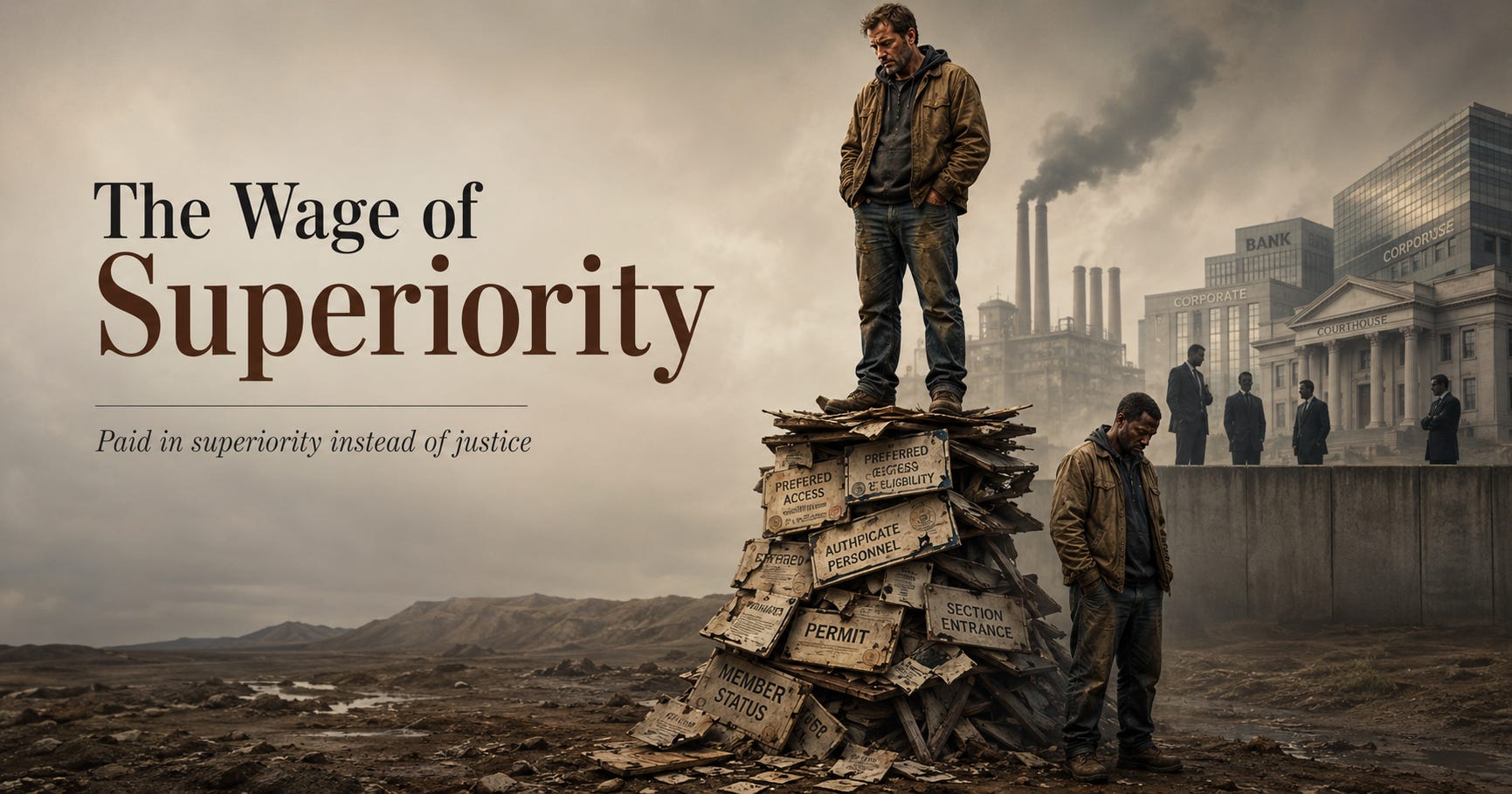
The greatest lie we have ever been told is a small one:
At least you are not him.
It is small on purpose. That is why it works.
It does not arrive sounding like hatred. It arrives sounding like comfort.
You are talked down to by people who have never done your job. You are ignored by people with money and titles—people who decide things about your life in rooms you will never enter.
Your knees hurt before the shift starts. Your truck needs work. Your kid needs shoes. You know exactly how much is left in the account before payday.
You do not own the factory or ship yard. You did not write the laws. You do not run the hospital, control the bank, or sit where the decisions are made.
But you were handed one thing.
At least you are not him.
That is the wage.
It is worth asking who pays it, what it buys, and whether you have ever once been allowed to spend it.
But first there is a simpler question—the one the sentence is built to keep you from asking.
Who is this “him”?
Before he was a threat, he was a man.
Before he was a category, he was a person.
He is tired too. He works too. He wants what you want: safety, pay, dignity, rest, and the chance to watch his children grow up somewhere that will not break them.
He was a neighbor before he was made into a rival.
He was beside you before he was placed beneath you.
That is the part the lie cannot survive.
Because the sentence only works if him stays a shadow. The moment he becomes a man again—a real one, with a face, a name, a body that can bleed, and a life that can be lost—the comfort curdles.
You begin to see what you were actually given.
And what you were quietly charged for it.
You were told you had won.
You were told you belonged to the side that matters.
You have not won.
You were paid in superiority instead of justice.
And the man you were taught to look down on was never beneath you.
He was beside you the whole time.
II. The Bargain
Here is what the wage feels like.
It feels like being let in.
You have spent your life outside the rooms where your future gets decided. Outside the good schools. Outside the clean jobs. Outside the tables where men with money and titles decide what your work is worth, what your town receives, what your children inherit.
You learned early that there is an inside and an outside.
And then you were told there was one place you already belonged.
One membership you did not have to earn.
One line you were already standing on the right side of, no matter how little you owned.
You belong to us.
To the side that matters.
To the people the country was supposedly built for.
That is not nothing.
To a man who has been given almost nothing, that can feel like a great deal.
That does not make you stupid.
It means the bargain was built to feel believable.
It gives you innocence. Whatever has gone wrong, it was not your fault. It was not your people’s fault. It was theirs.
It gives you a place. You are not at the bottom. There is a bottom, and someone else is in it.
It gives you a story. Your poverty is dignified. Your struggle is honorable. Your suffering belongs to the rightful, not the discarded.
And it asks for almost nothing in return.
It does not ask you to organize.
It does not ask you to fight your boss, your landlord, your senator, your debt, or the men who decide how little your life can cost.
It asks only that you look in one direction.
Down.
That is why the bargain holds.
It answers a real hunger with a real-feeling food: the hunger to matter, to belong, to not be the one everyone else is allowed to step on.
You wanted to be seen as someone.
And someone handed you a way to feel like someone—for free, or so it seemed.
So you took it.
Of course you took it.
A tired man does not always interrogate the one comfort he is handed. He holds it.
But look closely at the price.
The bargain asks only that you look down.
That is all.
Just look down.
But to look down on a man, you must first stop seeing him as a man.
You must turn a person into a direction.
That is the part of the bargain no one names.
III. The Substitution
Look at what you were actually handed.
You were not handed a man.
You were handed a word.
A picture.
A story about him that arrived before he did.
Threat. Criminal. Animal. Taker. Invader. Burden.
You were handed an object with his face printed on it, and you were told: this is him.
And the object was easier to hold than the man.
The man has a kitchen table. The object does not.
The man comes home tired. He takes his boots off by the door. He checks on his mother. He warms leftovers. He looks at a bill he cannot pay yet and folds it back into the envelope. His child asks him a question from the next room. For a moment, he just sits there, not because he is lazy, not because he is dangerous, but because the day has taken something from him too.
The object has none of that.
The object cannot look back at you. It cannot be tired the way you are tired. It asks nothing of you.
That is what makes it useful.
So you held the object.
And every time the man came near, you saw the object instead.
That is the trick at the center of the whole thing.
A part of him—a fear, a headline, a number, a story—was allowed to stand in for all of him.
A piece was made to replace the whole.
And once the piece replaced the whole, you no longer had to meet a person.
You only had to manage a thing.
People are not things.
But the bargain only works if you forget that.
It only works if a man can be folded down into a single word, and the word can be laid beneath you, and you can stand on it.
You did not invent that word.
You did not draw the picture.
You were handed it, already made—the way you were handed everything else you never chose.
Someone needed you to see an object where a man was standing.
Not by accident.
Because it paid.
Paid how?
A man who is busy looking down does not look up.
While you study him—while you watch him, fear him, resent him, measure yourself against him—you are not asking the question that would cost the people above you something.
You are not asking who profits from your disposability.
You are asking who is beneath you.
Those are different questions.
Only one of them is dangerous to the people who arranged your life.
He was supposed to be your rival.
That was the assignment.
A rival for the job, the house, the place in line, the country itself.
But a rival is only a neighbor you were taught to fear.
And as long as the two of you fight each other over the scraps, no one has to explain why there are only scraps.
You were given a thing to look down on.
He was the man it was made from.
IV. What It Bought You
So you were given a thing to look down on.
Now ask what it bought you.
Being above him did not raise your wages.
It did not lower your rent.
It did not heal your back, your lungs, or the parts of you the work wore down.
It did not keep the hospital in your county open.
It did not keep the plant from closing.
It did not clean your water, lower the price of medicine, or pull your child out of a school everyone else had already given up on.
Being above him gave you exactly one thing.
Someone to be above.
And here we have to be honest, because the lie depends on cheap answers.
Some of the wage was real.
Doors opened more easily for you.
You were trusted where he was watched.
You were given the benefit of the doubt he was denied—in the hiring office, the bank, the traffic stop, the courtroom.
That was not imaginary.
A man who tells you it was imaginary is asking you to disbelieve your own life.
But look at what kind of advantage it was.
It was an edge over the man beside you.
It was not freedom from the men above you.
You were handed a small, real head start in a race designed by someone else, on a road someone else owned, toward a prize someone else had already taken.
You got to be first among the disposable.
You got to be the most trusted of the people no one in power actually trusts.
You got to be told you belonged while still being used.
And you called that winning.
It was not winning.
The same machine that grinds him can still grind you.
It can underpay you.
It can deny you care.
It can poison you at work, bury you in debt, close your town, ship your job away, and walk away the moment your labor is no longer useful.
The wage of superiority does not protect you from the people who pay it.
It was never meant to.
That is the cruelty buried inside the comfort.
The bargain did not only fail to free you.
It gave you a way to misread your own suffering.
Every time the bottom fell out of your life, you had been trained to look sideways instead of up.
To find the man beside you instead of the system above you.
To ask, “Who is beneath me?” when the honest question was always, “Who is doing this to both of us?”
You were not given justice.
You were paid in superiority.
And superiority is a wage that buys almost nothing—except your silence.
V. Power and Permission
So name the bargain plainly.
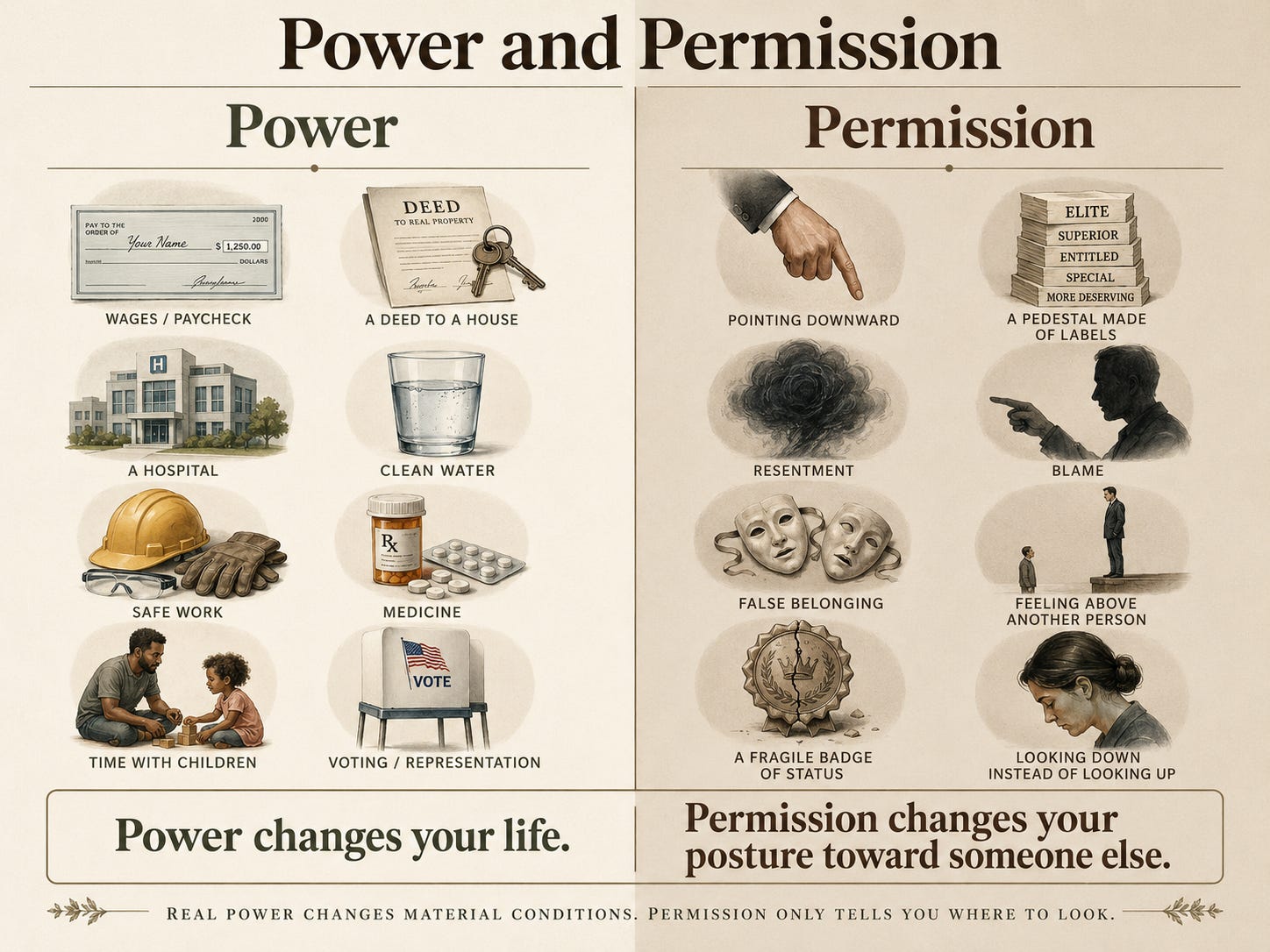
You were not given power.
You were given permission.
Those are not the same thing.
Power changes your life.
Power is the raise that clears the debt. The deed with your name on it. A hospital that stays open. Clean water. Safe work. Time with your children. Medicine you can afford. A vote that actually moves something.
Power lets you stand upright in your own life.
Permission does not.
Permission only tells you how you are allowed to stand toward someone else.
Permission says: look down.
Look down and feel innocent.
Look down and feel superior.
Look down and believe your suffering is more honorable than his.
Look down and believe your hunger is a tragedy while his is a verdict.
Look down and believe your hard luck is unfair while his was earned.
That is what you were given.
Not control over your life.
Permission to feel above another man.
Now notice why permission is useful to the people who hand it out.
It costs them nothing.
Power is expensive.
Power means wages, land, schools, hospitals, safety, representation, control, ownership, time, health.
Power has to be surrendered by someone who has it.
But permission is cheap.
They can give you permission all day: to resent, to blame, to feel wronged by him instead of robbed by them, to mistake your place above him for a place among them.
They lose nothing when they give you that.
Not a dollar.
Not a law.
Not a building.
Not a seat at the table.
That is why permission was always the thing they were willing to share.
W. E. B. Du Bois saw this clearly. He wrote about a public and psychological wage of whiteness—standing, deference, access, and belonging given to white workers even when they remained exploited.1
They were not paid enough in money.
So they were paid in status.
They were denied justice, then offered superiority as consolation.
That is the trade.
The system can take your justice with one hand, place a little superiority in the other, and tell you the debt is settled.
It is not settled.
You were not given power.
You were given permission to look down.
And a man who can only look down has not risen.
He has only been positioned—high enough to see someone beneath him, never high enough to see who put them both there.
VI. Who Actually Got Paid
So who actually profited?
Not you. Not in any deep sense.
You got the feeling of winning. Someone else kept the winnings.
You got the story that you belonged to the people on top, while they kept what mattered.
If permission was free to hand out, then someone was keeping the thing that was not free.
Someone always was.
The men who own what you work in.
The men who write the laws you live under.
The men who decide whether your town gets a hospital or a warehouse, a future or a closing notice.
The men who never have to choose between rent and medicine.
The men who need you angry, but not at them.
They are who the arrangement protects.
And it protects them only as long as you and he stay turned against each other.
Because there is a question that would cost them something:
Why are both of us breaking while someone else collects?
You are not supposed to ask that.
He is not supposed to ask that.
And the surest way to keep two men from asking it together is to make sure they never stand together long enough to notice they are asking the same thing.
This was built.
You can find the machinery in history.
In 1676, in Virginia, poor men rose up against the men who ran the colony. White and Black. Free and enslaved. Servants and laborers who had been worked to the bone.2 Men with different lives, different chains, different dangers—but for one frightening moment, some of them were pointed in the same direction.
Up.
The uprising was crushed.
But the men in charge had seen something they could not afford to see again.
Not the Black laborer alone.
Not the white laborer alone.
The two of them recognizing a shared enemy.
So the line hardened.
Not all at once.
Not out of nowhere.
The violence and contempt were already there.
But over time, law gave the poor white man a small rank above the Black man. A few protections for one. Deeper degradation for the other.
By 1705, Virginia’s codes had made that line more solid, more useful, more able to divide people who might otherwise have seen too much in each other.3
Even that small rank did not make poor white men equal to the powerful.
In the early republic, voting rights were controlled state by state. Many states kept property or taxpaying requirements that excluded poor men. Over the next decades, many of those barriers fell for white men, while racial barriers hardened for others.4
The lesson is not that poor white men held real power from the start.
The lesson is that they were gradually handed a higher place in the racial order without being handed control over the order itself.
That is not the whole history of racism.
But it is one window into the machinery.
The point was never simply to raise the poor white man.
It was to split him off.
To make sure that the next time the field filled with angry people, they would be angry at each other.
That is the machine, and it has been running in new forms ever since.
It does not require anyone to care about you.
It does not even require anyone to care about him.
It requires only that you keep looking upward at the powerful as your people, and sideways at him as your problem.
The line was never for your benefit.
It was for theirs.
It was done to him.
It was also done to you.
The same hand that gave him a chain gave you a counterfeit—and told you the chain was what made you free.
VII. The Strongest Objection
Here is where you might stop me.
And you would be right to.
You might say:
Fine. Say all of this is true. Say the bargain was built to use me. Say the men at the top played me. Say I was paid in superiority instead of justice.
I still came out ahead of him.
You admitted it yourself. The doors. The benefit of the doubt. The trust I get that he never gets. That is real.
And now you want me to hand it back for a solidarity that might never come. You want me to go first, to go alone, and to trust that he and everyone like him will be there to meet me.
And every reason you have given me so far has still been about me.
My loss.
My silence.
My freedom.
So why should I?
I am still winning.
That is the strongest thing you can say.
I am not going to pretend it away.
Because some of it is true.
The advantage can be real.
Counterfeit was my word, and it was too clean.
The belonging is counterfeit.
The wage is not always counterfeit.
Sometimes you really are treated better. And a man who tells you otherwise is asking you to disbelieve your own life.
So yes.
If everything I had said were only an argument about your benefit, you could close this page now and keep the deal.
A man who is winning is not moved by being told the game is unfair.
So let me stop arguing about you.
There is one thing I have not said plainly enough.
And it does not depend on you at all.
He is a person.
He was a person before the line was drawn.
Before the law was written.
Before the bargain was offered.
His worth did not begin when you recognized it.
It does not end when you withhold it.
It was never a thing you were handed the right to weigh.
It was simply true—the way it is true of you, the way it was true of you before anyone decided whether you mattered.
So hear the part that survives even if you are winning.
Even if the deal paid you.
Even if you came out ahead every time, in every room.
It would still be wrong.
Not because it failed to profit you.
Because you cannot be made better off by the erasure of a man and call the price fair.
A gain built on a person turned into a thing is not a gain you are allowed to keep.
Yes, the bargain harmed you.
That harm is real.
But it is the second harm.
The first was done to him.
You lost a fair shake.
He lost his standing as a man in the eyes of his own neighbor.
And that was never yours to take.
Everything before this was the door.
The argument aimed at you.
The reason that might get you to stand still long enough to look.
This is the room.
He is a person.
That was true before you walked in.
It will be true after you leave.
It does not need your permission.
It never did.
VIII. Recognition and the Collapse
So what happens when you finally see him?
Not pity him.
Not apologize to him.
Not mind your manners around him.
The system is not afraid of your guilt. Guilt can leave every line exactly where it is.
It is not afraid of your politeness. A polite man can still look down.
There is only one thing the arrangement cannot survive.
Recognition.
You look at him, and for the first time the object is not there.
The word is gone.
The story that arrived before he did has fallen away.
And what is left is a man.
A man who is tired the way you are tired. Who works the way you work. Who worries over his children the way you worry over yours. Who wants what you want—safety, dignity, rest, work that does not break him, a home that holds, a future his children can enter without being crushed.
Your lives are not the same.
He has carried things you have not. You have been handed things he never was.
But look at who arranged the difference.
Look at whose hand drew the line between you.
Look at whose pocket the difference has been filling all along.
Your wounds are not identical.
But many of them were made by the same people.
And once you see that, the questions change.
Not: how do I stay above him?
But: who taught me that I needed someone beneath me?
Not: what if he takes what is mine?
But: who has been taking from both of us while teaching us to fear each other?
Not: what if racism is just hatred?
But: what if it was a wage—paid to me in superiority so I would stop asking for justice?
Those questions cannot be unasked.
The moment they are asked, the bargain starts coming apart in your hands.
Because here is the thing you were never told.
The dignity you were given was not dignity.
Dignity does not need someone beneath it.
What you were given needed him underneath, holding it up.
Take him away and it falls, because it was never standing on its own.
You were not raised.
You were leaned.
You were propped against a man and told you were tall.
That is what the system loses when you finally see him.
Not a believer.
A buttress.
One of the oldest props it has, kicked out from under it by nothing more dangerous than a man recognizing a man.
You were told the whole time:
At least you are not him.
But you were never above him.
You were beside him.
In the same field.
In the same debt.
Under the same weight.
Being told the same lie in two different languages.
He was not your floor.
He was your neighbor.
You have not won.
You were paid in superiority instead of justice.
And the man you were taught to look down on was a person the whole time.
Not beneath you.
Beside you.
Originally published on An-Injustice!
W. E. B. Du Bois developed the idea of a “public and psychological wage” in Black Reconstruction in America. His point was not that poor white workers were materially free, but that whiteness paid them in status, deference, access, and public standing even while they remained economically exploited.
Bacon’s Rebellion is not the whole history of American racism, and it should not be reduced to a simple morality play. But it remains one important window into how colonial elites responded to the danger of cross-class, multiracial unrest by hardening legal and social distinctions between white and Black laborers.
The 1705 Virginia act “concerning Servants and Slaves” consolidated laws governing indentured servants and enslaved people, and Encyclopedia Virginia provides the primary text/context.
In the early United States, voting qualifications were controlled state by state. Many states used property or taxpaying requirements that excluded poor men. Over the early nineteenth century, many such barriers fell for white men, while racial restrictions hardened for many Black men and other nonwhite people.
References and Further Reading
Facing History & Ourselves. “Bacon’s Rebellion: Inventing Black and White.”
Encyclopedia Virginia. “‘An Act Concerning Servants and Slaves’ (1705).”
Jamestown-Yorktown Foundation. “A History of Bacon’s Rebellion in Six Sources.”