


Content note: This essay discusses childhood bullying, anti-gay slurs, family instability, homelessness, suicidal despair, psychiatric harm, and institutional failure. Some language appears because it was part of the harm being named, not because it is being endorsed.
This piece is written through a narrative name. It protects privacy, but it does not distance the wound.
The Performance of Ability
“High functioning” is not the absence of disability. It is often the visible performance of ability at the cost of long-term harm.
That is the cruelty hidden inside the phrase. It sounds generous. It sounds almost tender, as if someone has looked at a disabled person and recognized strength. Look how well he is doing. Look how capable he is. Look how much he can manage. But often what has actually happened is not recognition. It is convenience. The institution has seen that the person is not making enough trouble to require a response. He speaks well enough. He sits still enough. He completes the work. He follows enough of the rules. He does not interrupt the adult world in the right way, at the right time, with the right kind of suffering. So the institution calls him high functioning, and the category begins doing what categories do when they are allowed to become more real than the person. It makes the person easier to misunderstand.
Jeremy was eight years old, well-behaved, and good at his schoolwork. That was the first thing the system could understand about him. He was a good student, or close enough to one. He did not really make eye contact. He did not really socialize. He did not seem to know how to enter the easy language of other children. He was awkward in the body, awkward in the face, awkward in the small unsaid ways children notice immediately and adults somehow do not notice until they need a reason to correct them. He was the child nobody wanted to play with at recess, the child picked last, the child who learned the playground was not just a place to play but a little caste system with swings and dodgeballs.
Jeremy knew his place in it. Children always know. Adults pretend children do not understand social rank because adults do not want to admit how early the world starts teaching it. Jeremy understood. He was low. He was the socially awkward one. The clumsy one. The one whose body gave other children permission. When he flapped his hands, the joy went up out of him like birds, and someone always told him to put the birds away. His mother told him to stop because he looked retarded, so Jeremy stopped. He did what good children do when they are told their joy is ugly. He folded it away. He grew quiet the way a house grows quiet after the children are gone, which is to say it was not peace, it was only that there was no longer anyone inside making noise. He learned that even happiness could make him visible in the wrong way. He learned that his body could betray him before he even opened his mouth.
That was not a small lesson. That was the beginning of a life. Stop moving like that. Stop looking like that. Stop giving people a reason. The instruction did not need to call itself violence to become violence. It entered him as common sense. If people were cruel, maybe it was because he had failed to hide something. If people laughed, maybe it was because he had forgotten to perform correctly. If adults were embarrassed by him, maybe he had embarrassed them first by being what he was. The child began to learn a moral order in which the harm done to him always arrived with a little explanation attached. He looked wrong. He acted wrong. He spoke wrong. He moved wrong. Later, he would want wrong. Of course they treated him that way. What else should happen to a child like that?
The next summer, Jeremy learned homelessness. He learned what it meant to be loaded into a car with a small trailer and taken across the country to couch surf. He learned that a child’s life could come apart and still not become an emergency to the people with clipboards, gradebooks, offices, and mandated obligations. A new school should have meant new eyes. New teachers. A chance for someone to see the boy who did not make eye contact, did not really socialize, had just been carried through housing instability, and had already begun learning to make himself less visible. But nothing happened. Maybe it was 1998. Maybe autism was not yet legible to teachers in the way it might be now. Maybe that explains the failure. It does not make the failure harmless.
The institution received Jeremy as a student. That was the category available to it. Student. Maybe quiet student. Maybe odd student. Maybe good enough student. But not child whose body is trying to tell us something. Not child whose family life has collapsed. Not child who has learned that his safest self is the smallest one. The category was not false, exactly. Jeremy was a student. He was also a child, and the child was already asking to be seen in every way except the way the institution knew how to hear. This is the first danger of categories. They can hold one true thing about a person and still fail the person entirely.
The First Cage
By fourth grade, Jeremy was in his third school, and there he learned another rule. The other kids could call him a faggot and hit him, and somehow the teacher would never see. He did not know exactly what a faggot was yet. He knew only that the word belonged to him because other children kept handing it to him with their fists. He knew the word came before pain. He knew it made other children laugh. He knew it attached itself to whatever part of him other people had noticed before he had noticed it himself. So Jeremy did the math. He was. He must be. Children believe the world when the world is consistent enough.
This is how a category can become a cage before it ever becomes an identity. Faggot did not come to Jeremy as community, desire, language, pride, or future. It came as a social permission slip. Hit him. Laugh at him. Push him. Make him know. Make sure he understands that whatever he is, it is something other people get to punish. And because the teacher somehow never saw, or saw only the aftermath, or recognized only the disruption that followed, Jeremy learned that violence against him could become part of the room’s normal functioning. The classroom remained orderly enough. The school day continued. The adult kept teaching. Jeremy kept surviving. This is one of the ways systems hide harm: they allow a child’s suffering to become background noise, then congratulate themselves because the schedule was maintained.
Then one day a teacher finally noticed something true. Jeremy did not make eye contact. That could have been a door. It could have been the first adult question with enough tenderness inside it to matter. Why is this hard for him? What happens in his body when we demand this? Is he afraid? Is he overwhelmed? Is he autistic? Has anyone asked him? Instead, the teacher pulled him out of line and berated him in front of the class. Jeremy panicked and tried to do what she wanted. His eyes kept moving upward. He was trying to obey, but his body would not perform obedience correctly. Then even that became evidence. Now he was rolling his eyes.
A child can be converted very quickly. In a matter of seconds, Jeremy was no longer a frightened child trying to comply with a demand his nervous system could not meet. He was disrespectful. He was defiant. He had an attitude. The teacher had noticed him, finally, but only to punish the thing she noticed. Jeremy was confused because she was treating him like the other kids treated him. That was the year he learned the geography of danger. Students were not safe. Bathrooms were not safe. Classrooms were not safe. Teachers were not safe. There was nowhere in the school where his body could assume protection.
The next year was almost cheerful, if one tells it the way the world tells these things when it does not want to admit what happened. The game was called smear the queer, and Jeremy got to be the queer. He stood in the middle while another child distracted him and the others circled around, taking turns hitting him or pushing him back down. Day after day. He learned to fall in a way that hurt less. A child should not have to get good at being knocked down. Jeremy got good at it, the way he got good at his schoolwork, and the institution noticed only one of those. The name matters. Smear the queer was not a vague atmosphere of bullying. It was not peer conflict. It was not kids being kids. The game named the social logic out loud. Find the queer. Mark the queer. Hit the queer. Push the queer down. Laugh because everyone understands why this body is available.
There were adults around. That detail should not be passed over gently. There were adults around, and still the game continued. Maybe they did not see. Maybe they saw and thought boys will be boys, kids will be kids, he needs to toughen up, this is just how children are. Maybe Jeremy had already become the sort of child whose pain looked expected. But either way, the lesson was the same. His body was not fully his own. It belonged to whoever wanted to hurt it. If a child wanted to shove him, Jeremy’s body was there. If a child wanted to hit him, Jeremy’s body was there. If a child wanted a laugh, Jeremy’s body was there. The adults might intervene if his reaction became disruptive, but the first claim over his body did not belong to him.
That is what polite language tries to hide. Jeremy was not just teased. He was not simply having a hard time socially. He was living inside a system of permitted contact. His body could be shoved in a hallway because he was small. His head could be smacked in class because his credibility was already weak. His eyes could be demanded by a teacher because adult comfort mattered more than what eye contact did to him. His hands could be shamed into stillness because his joy made him look wrong. Over and over, Jeremy was taught that other people had more claim over his body than he did. They could correct it, mock it, hit it, read it, sexualize it, accuse it, restrain it, threaten to shackle it, or violate it. And if Jeremy objected, the objection became the problem.
That is what systemic violence often feels like from inside the child. Not one villain entering the room with a plan, but person after person accepting the same arrangement. A mother shames the movement. A teacher misses the slur. A teacher punishes the eye contact. Children make a game of the body. Adults remain near enough to count as witnesses and far enough to deny responsibility. The institution does not have to say Jeremy deserves it. It only has to behave, over and over, as if his suffering does not create an obligation.
Jeremy began putting it together. He was the queer. He was the faggot. He still did not understand the labels assigned to him, and he had not yet thought of boys or girls in that way, but the other children had helped him find the words for when the day came. One day his family had enough money for the $1.50 movie theater. There was a movie about a boat he wanted to see. Somewhere in the middle of it, he noticed a boy and felt something new. It was not dramatic. It was not safe. It was not the kind of moment people write in coming-of-age stories where the world softens around the child as he recognizes himself. Jeremy did not get softness. He got arithmetic. Two plus two. Life started to make sense. The other kids had known before him.
That should have been tender. A boy noticing another boy should be allowed, at least once, to belong only to himself. But Jeremy’s self-recognition had already been contaminated by other people’s disgust. He did not discover desire and then learn the world might hate it. The world hated it first, named him first, hit him first, laughed first, and only afterward did Jeremy find the feeling under the bruise. By the time he understood that he liked boys, the word faggot was already waiting for him like a verdict. It explained the playground. It explained the hallway. It explained the teachers who did not see. It explained why he was treated like something that could be harmed without consequence.
Home did not rescue him from any of this. His mother was unstable with schizophrenia. His father was present in the way a person can be present and still unavailable. They were both there and not there, and Jeremy learned to live in that contradiction because children do not get to choose the emotional architecture of the house they are born into. He did not really have a mother in the way a child means mother. He did not really have a father in the way a child means father. He had adults in the house sometimes. He had moods to read. He had slurs to hear. He had instability to track. He had silence to survive.
The slurs did not stay at school. That would have been too merciful. At home, the television could become another classroom. Someone on the screen, someone in the family, someone out there in the world could be called faggot, queer, disgusting, wrong, and Jeremy understood that these words were not floating in the air without destination. They landed somewhere. They landed in him. Around the clock, all day, every day, every week, every month, year after year, Jeremy was taught the same lesson in different rooms. At school, children taught it with their hands. At home, adults taught it with disgust. In public, the world taught it through jokes and warnings and news stories about what happened to boys like him. The curriculum never ended.
His parents were present in the way institutions sometimes are present: near enough to shape the harm, absent enough to deny responsibility for it. His mother could injure with words, with instability, with suddenness. His father could be there and still not protect. Jeremy learned their moods the way he learned hallways at school. He learned when to speak, when not to speak, when to disappear, when to take care of his sister, when to expect nothing. A child should not have to become fluent in absence, but Jeremy did. He held together what he could because his little sister depended on it. That was the one relationship that did not feel abstract. Not a category. Not a file. Not a grade. Not a slur. His sister was real.
When CPS came, Jeremy knew the drill. CPS was not there to be your friend. CPS was there to take you. That is another moral failure. A child should not experience the child protection system as one more danger to survive. Maybe individual workers cared. Maybe some did what they could. But Jeremy’s knowledge of the system was already shaped by threat. Adults could arrive, ask questions, decide things, move children, and leave. The system might recognize risk. It might recognize custody. It might recognize a case. But recognition of a case is not the same as recognition of a child.
Then came another move, another state, another new home, another chance to become unknown. Nobody knew him there. Maybe it could be a fresh start. He would only have to hear the slurs at home about random people on television or about his cousin. Middle school arrived. Jeremy was small, about 5’3” and 110 pounds, and in the crush of the hallway he learned that he could be pushed from one side to the other almost as if his body were part of the architecture. The boys were bigger now. Stronger. The tactics had not changed, but their bodies had. By then Jeremy thought he had learned how to hide. He watched his voice, his walk, his face, his hands, his softness, the amount of space he occupied. He thought maybe if he planned carefully enough, nobody would know.
But they knew. Soon the hope of new friends and comfort at school faded into the old reality. None of this would be happening if he were not a faggot. That is what Jeremy believed because that is what every system around him kept teaching. If the harm is repeated enough, and no one stops it, a child begins to assume the harm belongs to the nature of things. Then one night the news came on. There was a boy like him. Other boys found out. They took him out to the country, tied him to a fence, and beat him to death.
Jeremy learned to listen louder after that. He listened to his voice. His clothes. His hands. His walk. His face. His interests. The way he stood. The way he looked at another boy or did not look. Smear the queer was not just a schoolyard game anymore. It was the operating logic of the world. It meant that if he was visible in the wrong way, people might not merely laugh. They might decide that his body was available. They might decide that his life was already worth less. The lesson was not theoretical. It had a body tied to a fence.
Shortly after learning about that boy on television, Jeremy had a particularly cruel day at school. He went home convinced it would never end. He was twelve. Nobody was home. He broke down crying into his bed, and then he thought maybe God would help. So little Jeremy prayed his heart out. He told God he could not take it anymore. He had had enough. He prayed that God would let him not wake up. Then his tears dried, and he fell asleep. In the morning he woke up, and he understood what that meant. Jeremy never prayed again.
He did not stop believing in God. He stopped believing God would help him. There is a difference, and Jeremy learned it at twelve. This is where the story becomes almost unbearable, because Jeremy did not simply conclude that God had not helped him. He concluded the world made sense. He knew what the Bible said. He was a disgusting faggot. God did not need to tell him that; everyone else already had. If God left him there, maybe God agreed. If adults watched and did nothing, maybe adults agreed. If teachers punished him, maybe teachers agreed. If children hit him, maybe children were only saying out loud what the world already knew. Jeremy learned to survive inside a terrible moral equation: the suffering kept happening, therefore perhaps it was deserved.
The case against Jeremy was airtight. The children had built it with their hands. The teachers had certified it. His mother had notarized it with a word. God had declined to appeal. By twelve, Jeremy had read the verdict and found it fair, because a verdict everyone agrees to stops looking like a verdict and starts looking like the weather. Nobody argued. There was nothing to argue. The boy was guilty of being the boy.
And still he held his grades together. This is where “high functioning” becomes obscene. The gradebook can launder almost anything. It can turn a child’s terror into evidence of competence. It can say he is passing, so he is managing. It can say he is smart, so he needs less. It can say he is quiet, so there is no emergency. It can say he has no obvious behavior problem, so nobody has to ask what kind of child goes home and prays not to wake up. The institution saw the completed work. It did not see the bargain underneath it. Jeremy was purchasing legibility with pieces of himself.
The gradebook can launder almost anything.
In high school, a few teachers had a softer side for Jeremy. That matters. Tenderness always matters, even when it arrives inside a system too weak to save anyone. An English teacher had a softness. A science teacher had a softness. Maybe they saw a little of him. Maybe those moments helped him survive longer than he otherwise would have. But the system as a system mostly noticed Jeremy when his distress became inconvenient. A vice principal began to take note of his increasing behavior problem. Not the slurs. Not the hitting. Not the homelessness. Not the undiagnosed autism. Not the queer terror. Not the child who had been parenting his sister emotionally long before any adult would name it. The behavior problem.
This is how substitution works. The person disappears, and the category walks into the office in his place. Behavior problem is easier than child in pain. Disruptive is easier than child no one protected. Difficult is easier than child who has run out of ways to survive politely. Once Jeremy became a behavior problem, the system could finally recognize him without recognizing what it had done.
When Disgust Became Curriculum
Health class made the disgust official. Jeremy knew the gay part was coming. First the heterosexual sex education, then the required sidebar about the gays. On schedule, the other kids looked over at Jeremy and snickered because everyone knew who the lesson was about. Mr. Stevens announced that he would rather not teach this but it was required, and then he went into his diatribe about how disgusting gay sex was, complete with the face, the tone, the performance of revulsion. For Jeremy, it clicked. He still was not quite sure how sex worked, but he understood enough. He was a disgusting faggot. The treatment made sense now. Why would anyone be kind to what brings disgust? Whose life taken is just another faggot? AIDS would have taken them anyway.
That was not simply a bad health lesson. It was an adult using institutional authority to put disgust into the curriculum. It taught the other students that their cruelty had a witness. It taught Jeremy that the school could place an adult at the front of the room to say, in effect, yes, this is what you are. The system did not need to strike him to participate in the violence. It only had to make the room safe for disgust and unsafe for the child who was its object.
The teen years went on, and Jeremy measured everything by safety. He listened for which kids were taking which classes so he could know which rooms to avoid. He liked art, but art asked him to do the one thing he had spent his life learning not to do. How does one express himself through art if he cannot express himself? By seventeen, Jeremy was wise for his age, which is what people say when they do not want to say that a child has been made old by fear.
Then came chemistry. The students took turns smacking him across the head whenever he tried to pay attention. At first he protested, but the teacher shut him down. The smacks continued. Then a girl threw a condom toward the teacher, and when the teacher turned around furious, the class turned Jeremy in before Jeremy could even understand what had happened. By then the teacher had had it with Jeremy disturbing class, so the vice principal was called.
Jeremy tried to explain. That is the part that hurts. After everything, some part of him still believed that if he could just get away from the crowd and tell an adult what happened, the truth might matter. Instead, the vice principal put two fists against his chest and pushed him back into the wall. The message was clear. If his behavior persisted.
That was a whole education in one gesture. Jeremy was not the student being assaulted. He was the disturbance. He was not the child trying to tell the truth. He was the behavior problem. His credibility had been spent before he opened his mouth. When he got home that day, he knew he could not go back. They were going to hurt him, and nobody was going to stop them.
Safety as Absence
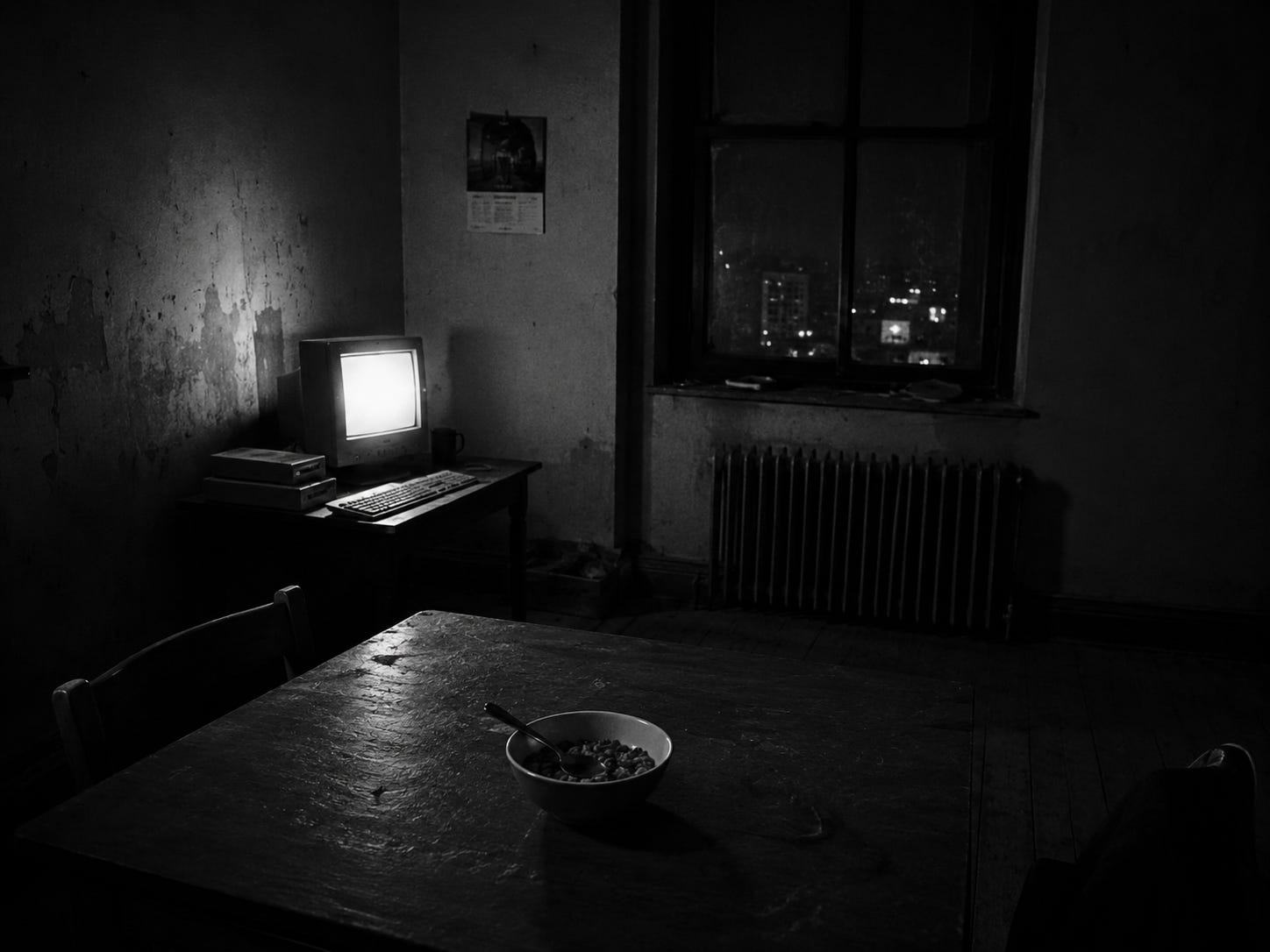
By then his mother and father had left home. Home became peaceful in the bleak way an abandoned house can be peaceful. Food was sporadic. So were the lights. But with nobody there, nothing could hurt him. He kept the lights off even when they worked, because the dark cost nothing and nobody could find him in it. He ate cereal without milk. He learned which floorboards were quiet. At night the computer was the only thing in the house that made a sound, and he was grateful for it the way you are grateful for a thing that does not ask anything of you. A boy should have someone to come home to. Jeremy came home to a screen, and that was the gentlest part of his day. That is what safety had become to Jeremy: not love, not protection, not care, just absence. His days became unstructured, hours and days of silence and computer solitude. Nobody really seemed to require him to be a child anymore.
Then one beautiful spring morning he heard screeching outside. His mother was there, irate, dragging his little sister by the hair while the child’s small feet tried to keep up and her knees scraped the pavement. A few moments later, his mother threw her onto the porch and said, “Take the little cunt.” That morning Jeremy became a father without warning. Silly him, unprepared. He called a friend in college because she was smarter than him. He signed his sister up for school. He cleaned the house. He got a job. He handled CPS. He was awarded temporary custody.
His sister was not a category to him. She was not a dependent, not a minor, not a placement issue, not a custody matter. She was his little sister. She used to fall asleep on him during the movies they could afford on the cheap nights. He stayed still so she would not wake up, even when his arm went numb. That was the whole of his religion by then: keep still, let her sleep, do not let anything reach her. He was a child being a church for another child. In a life where mother and father had become words without reliable meaning, she was the person who made Jeremy necessary. He had always cared for her in the ways children care when adults leave gaps too large for children to fill and then act surprised when the child climbs inside them anyway. She depended on him, and he depended on being depended on. That is not the same as being supported. It is only what a child builds when support does not arrive.
The system saw that Jeremy could do it. That is the part that should make the reader feel ill. It saw him fill out forms, clean the house, get a job, sign her up for school, answer the questions, perform emergency adulthood. It saw that he could be used as a solution. The child no one had protected became useful once another child needed protection. And because Jeremy had been living alone anyway, because he had already been surviving without parents in any meaningful sense, because he had already been made old by neglect, the system could allow itself to treat his capacity as if it were natural. Look how responsible. Look how capable. Look how high functioning.
But carrying too much is not capacity. It is abandonment with a better public face.
But carrying too much is not capacity. It is abandonment with a better public face.
Then his father came home the following summer. The divorce had settled. His sister would be moved across the country to live with another sister. Jeremy protested, but nobody listened. That was one of his great failures, or at least that is how it entered him. He had done the work. He had kept her safe. He had signed the forms and cleaned the house and gotten the job and stood between her and the emptiness the adults had left behind. He thought he had done well. He thought he had held it all together. He had been holding it together for years, so of course he thought he was doing it right.
But they took her anyway.
He had thought doing it right would be enough to keep her. That was the last time Jeremy believed effort protected anyone. The system had praised the very thing it was about to overrule. It called him capable while it took away the person his capability was for.
Other family members had been allowed to leave. Adults had been allowed to disappear, unravel, return, decide, arrange, relocate, and call it life. Jeremy had stayed. Jeremy had cared. Jeremy had become what was needed because nobody else did. And in the end, his sister was cruelly taken across the country, and Jeremy was left behind as if his attachment did not count because he was not the right kind of adult, not the right kind of parent, not the right kind of person to be grieved. After all, he had already been living by himself for two years. After all, he had already proven he could survive being forgotten.
This is the violence of institutional categories. Sister becomes placement. Care becomes temporary custody. A child’s love becomes an arrangement to be superseded. Jeremy’s grief becomes administratively irrelevant. The system could recognize that his sister needed somewhere to go. It could recognize that legal adults had claims and custody structures and decisions to make. It could not recognize what it meant for Jeremy, who had almost no one, to lose the one person who had made him feel like staying alive had a task attached to it.
His father realized Jeremy was eighteen. Eighteen, with an eleventh-grade education. Autistic. ADHD. Undiagnosed. And just like that, into the world. The life of an autistic. That is what remained after all the systems had finished with him. No real mother. No real father. His sister gone. School gone. Childhood gone. Explanation gone. Jeremy left with himself, which was the one thing he had spent his whole life trying to make small enough to survive.
The Category Walked In
At twelve he had prayed not to wake up, and woke up anyway. Years later he tried to finish what the prayer started, and woke up anyway. The second time, there was a cop in the room. He woke up in intensive care, scared, with nobody telling him what was going on. The cop told him to chill. The other option was being shackled to the bed. So Jeremy knew what to do. He shut down. Of course he did. He had been trained for this since childhood. Get quiet. Get small. Do not make them angrier. Do not give them a reason. Become manageable. Even there, after everything, the system did not first meet him as a terrified person waking up after trying not to live. It met him as a risk, a body, a behavior to control.
In inpatient psych, they gave him tests and questionnaires. Jeremy was confused by the questions, so he asked for clarity, and they told him they could not help. So he answered as best he could. Later, the psychiatrist asked why he had made up his answers. He tried to explain, but she would not have it. That was his first lesson from psychiatry: his credibility did not matter. The form mattered. The answers mattered. The interpretation mattered. The suspicion mattered. Jeremy, trying to explain that he had not understood, did not matter enough to believe.
The next day, all Jeremy wanted to know was what was wrong with him. The psychiatrist, concerned that people might abuse the welfare system, told him she did not want to give him information that could help his “story.” His story. Jeremy was not asking for a story. He had been trapped in other people’s stories his entire life. The faggot. The problem. The behavior. The manipulator. The disturbed one. The one who brings it on himself. He was asking for a name for the pain he had carried since childhood. When he said, “I just want to know why I feel this way and what is wrong with me,” she looked at him and said, “I don’t know, maybe borderline personality disorder.” Then the visit ended.
No explanation. No careful assessment of autism. No recognition of trauma. No curiosity about the child who had learned to survive by disappearing. No interest in what the questionnaires had failed to capture. Just maybe borderline. Jeremy understood. The problem was his personality. The problem was him. That had always been the lesson anyway. The children had said it with slurs. His mother had said it with shame. The teachers had said it with punishment. The vice principal had said it with fists. The health teacher had said it with disgust. Psychiatry said it with a category. Every adult who ever hurt him had told him the same thing in their own way. The psychiatrist was just the first one with a diagnostic code.
This is why the category is not the person. Jeremy was not first recognized as an autistic child with support needs. He was recognized as awkward, then faggot, then disrespectful, then target, then behavior problem, then temporary caregiver, then risk, then unreliable narrator, then maybe borderline. Each category arrived after someone had already failed to recognize the child. Each category made him easier to handle, easier to dismiss, easier to blame, easier to move along. None of them told the truth.
The truth was that Jeremy was a child whose hands moved when joy got too big. A child called faggot before he understood desire. A child who lived through smear the queer not as a metaphor but as a game children played with his body. A child who heard the slurs at home, at school, in the culture, in the little side comments adults thought did not matter. A child who learned adults could watch violence happen and still do nothing. A child who prayed not to wake up and woke up anyway. A child who became a parent before he became an adult. A child who lost his sister and was expected to continue because he had already proven he could live without being cared for. A child who survived so convincingly that every system around him mistook survival for capacity.
That is the violence of “high functioning.” It looks at what a child was forced to perform and calls it who he is. It sees the mask and misses the wound. It sees the grades and misses the prayer. It sees the silence and misses the terror. It sees caregiving and misses abandonment. It sees survival and calls it ability.
Everyone agreed about Jeremy. The children agreed. The teachers agreed. His mother agreed. The doctor agreed. Even God, when asked, said nothing, and a silence like that sounds a great deal like agreement. So let the record show one dissent. One. Filed too late to help him, by someone who was not there, against a verdict the whole world had already signed.
The category is not the person. Jeremy was there the whole time.
The category is not the person. Jeremy was there the whole time.
Joshua Sandifer, NP-BC, is an autistic writer and nurse practitioner whose work examines dignity, disability, trauma, queerness, faith, and institutional failure. He writes from the place where survival was once mistaken for capacity, and where categories arrived long before recognition. He writes The Legibility Project and is developing People Are Not Things, a broader project on personhood, recognition, and institutional life.
Thank you so much for writing this incredibly powerful piece. Your words are haunting and brilliant and rip the facades of our society to shreds. I feel so sad that ‘Jeremy’ went through this. And that so many other others are too. You are doing important work. ✨
I high functioned until I became a mother, then I was just another parent looking for help and getting laughed at. Not the violence people immediately think of, but I’m not laughing.