


There is a sentence I have come to distrust on almost any form: yes or no.
Not because yes or no questions are always bad. Sometimes the answer really is yes or no. Do you have chest pain? Are you allergic to penicillin? Have you fallen in the last thirty days? These questions matter. I am not making an argument against documentation, categories, or standards. That would be absurd coming from someone who works in healthcare.
But there are also questions where yes or no is not an answer. It is a trap door.
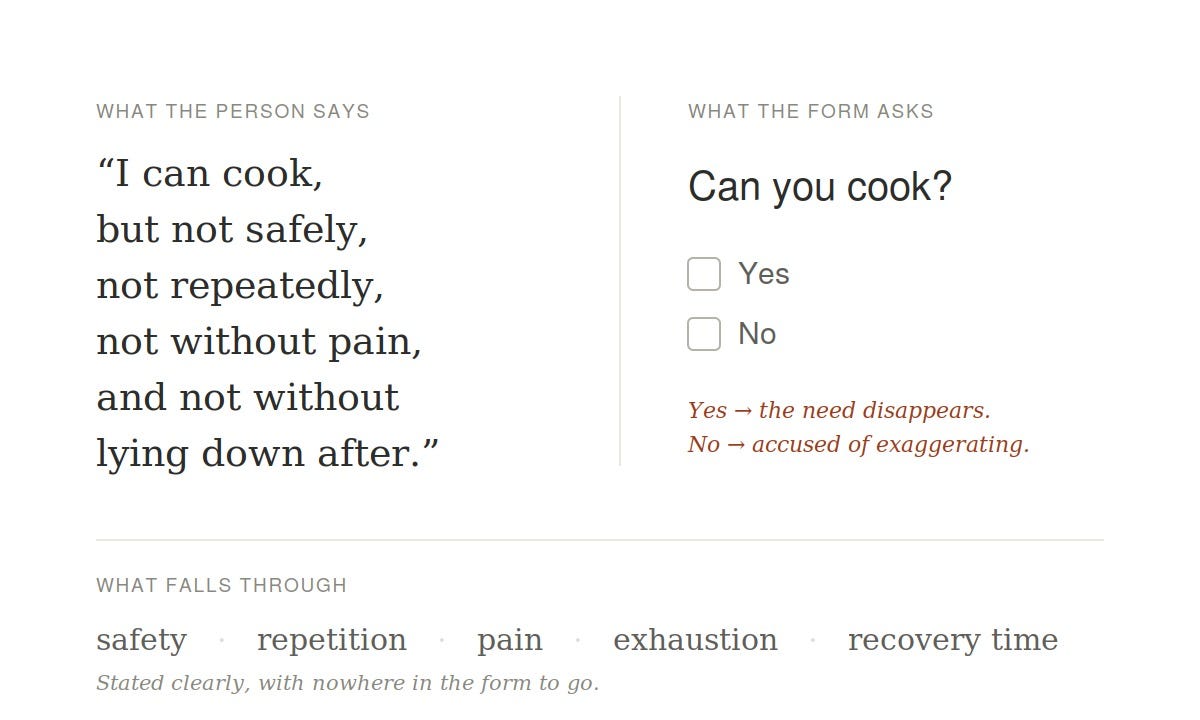
A disabled person says, “I can cook, but not safely, not repeatedly, not without pain, and not without needing to lie down afterward.” The form asks, “Can you cook?” The person has to choose. If they say yes, the need disappears. If they say no, they may be accused of exaggerating, because technically they can make something once. The truth is not absent. The truth was stated clearly. The institution just did not build a place for it to go.
That is the part I keep circling. A person can tell the truth and still become unknowable to an institution. Not because they were unclear. Not because they failed to advocate. Not because they needed to “communicate better,” which is what people say when they do not want to admit the receiving system is badly built. The truth can be present, spoken, documented somewhere in fragments, and still fail to become actionable because it entered the institution in the wrong shape.
This is one of the quieter ways institutions harm people. It is not always dramatic. It is not someone yelling at the desk or a clinician being openly dismissive or an agency denying a claim with obvious cruelty. Sometimes the harm is colder than that. The institution asks a question too narrowly, receives a distorted answer, and then treats the distortion as if it came from the person.
We talk as if institutions simply collect information. A hospital takes a history. A school reviews a record. A benefits office processes an application. The institution gathers facts and acts on them. That is the polite story, and I understand why it exists. Institutions need to believe they are acting on facts rather than producing the conditions under which certain facts can appear. But institutions do not simply receive reality. They organize it before it arrives. They decide what kind of information matters, what kind of answer can count, what kind of evidence travels, and what kind of person can be recognized inside the system.
This is what James C. Scott called legibility. States simplify complex human life so it can be administered from a distance: they map, name, count, standardize, and classify until local complexity becomes something manageable from above. The state cannot see everything, so it makes reality easier for itself to read. I want to borrow that idea and bring it inside the clinic, the school, the benefits office, the nursing home. I think of it as clinical legibility: the conditions under which a person’s real signs, words, and needs can actually be recognized by an institution and acted on. A person can be perfectly visible and still fail to be legible. That gap is where the harm lives.
Every institution has a theory of the person, and you can usually find it in the form.
I mean that literally. The intake form, the eligibility checklist, the risk score, the progress note, the billing code, the survey tag, the productivity metric, the algorithmic score: these are not just administrative tools. They are little theories of what a person is, what a person needs, what counts as proof, and what parts of a human life are worth carrying forward. A person arrives whole, but the institution receives them in pieces. Diagnosis. Income. Risk. Compliance. Score. Eligibility. Some translation is necessary. No medical record can hold everything a person is. A disability form cannot hold every hour of exhaustion. A nursing home survey cannot fully hold fear, humiliation, and the long aftermath of being made unsafe in a place meant to care for you.
Still, there is a difference between necessary reduction and degrading reduction. There is a difference between summarizing a person so care can happen and shrinking a person so the system does not have to respond.
A form is not neutral. It is not a container waiting innocently for information. A form is an argument about what information matters. It tells the person, before they have answered, what kind of reality the institution is prepared to receive. If the form only asks whether you can cook, it has already decided that safety, repetition, pain, and recovery time are secondary unless you can force them into a box that was not designed for them.
The same thing happens in clinical spaces. An autistic patient says, “I listen better when I do not make eye contact.” That is a clear statement. It gives the clinician exactly the context needed to avoid misreading the encounter. But the note may still say “poor eye contact,” as if the absence tells the truth more accurately than the patient’s own explanation. This is not a small documentation issue. A note travels. It shapes the next encounter. Before the patient has spoken again, the record has already started talking. It may say guarded, odd affect, difficult historian, anxious, unreliable. Then the patient spends the next visit climbing out from under a description they did not write. People who have been misread by institutions know this. You are not just entering a room. You are entering a record already in motion.
Nursing gives me another way to see it. A nurse may know a patient is getting worse before the score knows. The breathing has changed. The patient looks different. The family says, “This is not them.” The story does not fit the vital signs, but the number has not crossed the threshold. I am not romanticizing intuition. Nurses can be wrong. A score can be useful. A threshold can prevent chaos, because otherwise everything depends on who is working, how tired they are, and whether the receiving clinician takes them seriously. But the score is not God, and the threshold is not reality. A number can organize judgment; it should not replace it. When the nurse’s concern cannot become actionable until the score gives permission, the institution has decided what kind of knowledge counts. That decision is not neutral.
I have been thinking about this with RVUs too. A billing code can capture the visit, but not the value of the care. It can capture the billable encounter, but not clinical judgment, patient education, medication reconciliation, care coordination, trust-building, or the crisis that did not happen because someone paid attention early enough. Prevention is especially hard for institutions to value, because the proof of good work is often that nothing exploded. Institutions are not good at honoring the non-explosion. That is the strange thing about scores: they look like measurement, but they teach institutions what to value. Once a score becomes the dominant language, the parts of care that cannot be scored begin to look soft, optional, inefficient, or invisible. The work did not stop mattering. The institution learned not to see it.
Categories do something similar. As Bowker and Star showed, categories do not just label the world after the fact; they shape the world institutions can act on, making some things visible and others residual. Some people fit cleanly. Some are bent until they fit. Some become edge cases, noncompliant cases, unclear cases, problems. The category is supposed to help the institution see the person. The danger begins when the institution sees only the category: when a diagnosis becomes the whole person, a risk score becomes the whole clinical picture, a survey tag becomes the resident’s public story, a chart note becomes the patient’s credibility. Once that happens, the person is no longer meeting the institution as themselves. They are meeting it through its prior description of them. Sometimes that description is useful. Sometimes it is necessary. Sometimes it is dead wrong and still durable.
This is not just a language problem. It is a problem of institutional knowability. How does an institution come to know a person? Through which forms, whose words, which scores, which thresholds, which authorities? And what does it fail to receive because its pathways were never built to carry it?
Institutions love thresholds because thresholds make action defensible. A score reaches a number. A lab crosses a cutoff. A complaint is substantiated. A patient qualifies. The threshold gives everyone a place to stand. I understand the appeal. In healthcare, thresholds save lives. In benefits systems, eligibility criteria protect against arbitrary judgment. In regulation, standards make accountability possible. The problem is not that thresholds exist. The problem is that human need often appears before the threshold does. The nurse may know before the rapid-response score knows. The patient may be suffering before the lab crosses the line. The disabled person may be unsafe before the form recognizes dependence. The resident may be degraded before the survey category can hold the injury. A threshold can be useful and morally dangerous at the same time. Institutions prefer to treat the threshold as reality itself, rather than a tool for responding to reality. But a tool is not the world. A score should help us see. It should not give us permission to stop listening.
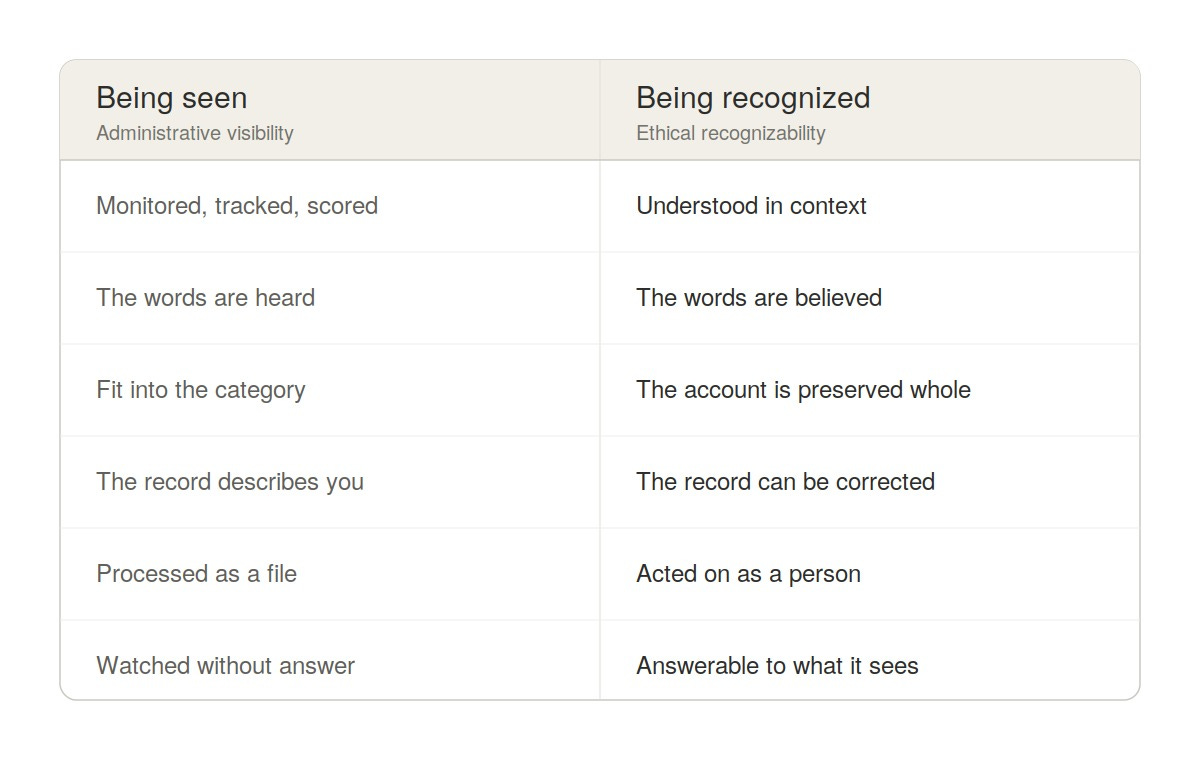
All of this is what I mean by recognition infrastructure: the forms, records, categories, measurements, vocabularies, thresholds, and authority pathways through which people become knowable inside institutions. It determines whether someone’s reality can be noticed, believed, documented, transmitted, acted on, and corrected. I know that is a mouthful. I also think we need it, because “being seen” is too vague. Institutions see people all the time. They monitor, track, score, audit, bill, classify, and surveil them. Visibility is not recognition. Sometimes visibility is just another way to be reduced. Recognition asks the harder question. Did the system receive what mattered? Did it preserve the person’s account without degrading it? Did it let concern travel? Did it make action possible? Did it give the person any way to correct the record when the record got them wrong?
This matters because institutions often blame people for the failure of the receiving system. If the person cannot fit the box, the person is called unclear. If the story does not match the form, the person is called inconsistent. If the need appears before the threshold, the person is called dramatic, anxious, or not yet eligible. If the communication style does not match the institution’s preferred performance of credibility, the person is called disengaged, guarded, or difficult. If the work does not convert into a billable unit, the work is called low value. This is one of the oldest institutional tricks: build a narrow doorway, then call people malformed when they cannot pass through it. Illegibility is not always the person’s failure. Sometimes it is the institution confessing the limits of its own design.
Better institutions require better ways of knowing. That does not mean more surveillance, more checkboxes, more dashboards, more scoring systems. Institutions already know how to make people visible in ways that are burdensome, reductive, and punitive. Being watched is not being recognized. Being processed is not being understood. The goal is not to make people endlessly visible. The goal is to make institutions answerable to what they see. That means forms that allow narrative and context, records that can be corrected, categories that stay tools instead of becoming verdicts, thresholds that support judgment instead of silencing it, and authority pathways that let frontline knowledge travel.
In healthcare, that means asking whether our instruments work equally well across bodies, whether clinicians are trained on the full range of human presentation rather than the bodies most often centered in textbooks, and whether electronic health records preserve patient testimony and nursing concern or flatten both into templates that travel badly. In disability systems, it means asking whether forms can hold fluctuation, fatigue, collapse, recovery time, and the difference between doing something once and doing it safely, repeatedly, and sustainably. In workplaces, it means asking whether productivity systems can recognize invisible labor, prevention, repair, mentoring, and the value of things that did not fall apart because someone quietly held them together.
A humane institution is not one that abandons categories. That would not work. A humane institution is one that remembers categories are tools. The label is not the person. The score is not the person. The diagnosis is not the person. The note is not the person. Institutions have to be forced to remember this, because they are always tempted to confuse the administrative version of someone with the human being who exceeds it. When the file replaces the person, the institution can act with great confidence and very little understanding. It can deny care, delay treatment, reduce services, assign risk, close complaints, and call the process objective.
But objectivity is not the same as justice. A system can be consistent and still be wrong. It can be standardized and still be narrow. It can be evidence-based and still be built from evidence that excluded the people now being judged by it. It can be efficient and still be morally stupid. This is why reform cannot stop at telling professionals to be kinder or more aware of bias. Those things matter, but a kind person inside a badly built system may still be forced to translate a human being into categories that cannot hold them. A compassionate nurse may still struggle to make concern actionable before the threshold is crossed. A careful clinician may still inherit a chart already loaded with credibility judgments. Empathy cannot compensate forever for infrastructure that keeps misrecognizing people.
At some point, the institution has to be rebuilt. The form has to change. The category has to loosen. The record has to carry more truth. The threshold has to make room for judgment. This is not a demand for perfect recognition. No institution can know a person completely. No form can hold a whole life. But institutions do not have to know people perfectly in order to stop knowing them badly. They can be designed to receive more truth than they currently do. They can be audited for what they miss. They can be forced to explain why certain kinds of need have no field, why certain kinds of testimony carry less credibility, why certain kinds of work do not count, why certain bodies are measured less accurately, and why certain harms vanish unless they fit the available box. What institutions build, institutions can rebuild. And what they can rebuild can be demanded of them.
The question is not whether institutions have enough information. Most have more than they know what to do with. The deeper question is whether they have built a world in which the truth about a person has somewhere to go.
Because when there is no field for the truth, the institution does not become neutral.
It becomes ignorant by design.
Josh Sandifer is an infectious disease nurse practitioner and independent scholar in Northwest Indiana. He writes on recognition, dignity, and institutional failure, asking how people become visible to the systems meant to serve them without being reduced to a file. His work develops the idea of clinical legibility: the right to be seen without being degraded.